









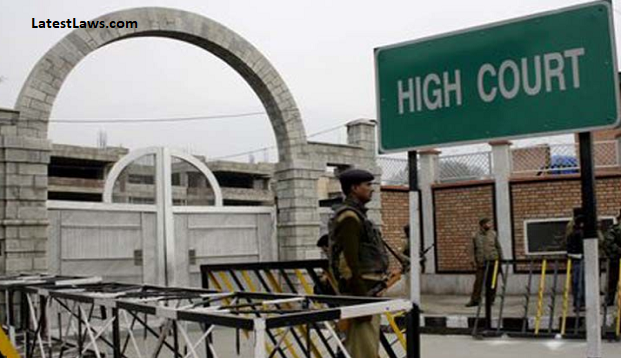
The High Court of Jammu & Kashmir and Ladakh at Srinagar, in a significant ruling pronounced on May 15, 2026, dismissed a petition filed by senior officers of J&K Bank Ltd. seeking to quash FIR No. 14/2019 registered by the Anti-Corruption Bureau, Srinagar, for offences under Section 5(1)(d) read with Section 5(2) of the J&K Prevention of Corruption Act and Section 120-B RPC. The matter was heard and decided by Hon'ble Mr. Justice Sanjay Dhar.
The case traces its origins to allegations that the then Chairman of J&K Bank, Shri Parvez Ahmad Nengroo, entered into a collusive insurance deal with M/S IFFCO Tokio General Insurance Company Ltd. in February 2019, supplanting the Bank's long-standing arrangement with Bajaj Allianz General Insurance Company Ltd., which had been in place since 2002. The Anti-Corruption Bureau alleged that the motive behind the new deal was to facilitate the appointment of one Asif Manzoor Beigh — a close relative of the Chairman — as General Manager in IFFCO Tokio at a package of Rs. 19.28 lakhs per annum, more than double his previous salary of Rs. 8.75 lakhs. This appointment was found to have occurred just a day after the MoU between the two entities was signed, establishing what the investigating agency characterised as a clear quid pro quo.
The four petitioners — senior executives of J&K Bank who served as members of the bid-evaluation committee — sought quashing of the FIR, contending that their role was limited to evaluation of proposals and that they had no connection with the appointment of Asif Manzoor Beigh. Their counsel, Mr. Z. A. Shah, Senior Advocate, further argued that bid scores awarded by expert committees are inherently subjective and that the alleged loss in bank commission calculated by the investigating agency was speculative, as commission earnings depend on multiple variable factors. The respondent — the UT of J&K through the ACB, represented by Mr. Mohsin Qadiri, Senior AAG — countered that the Chairman had personally participated in the evaluation process, compromising the integrity of the committee, and that expert analysis of the presentations had established that undue advantage was extended to IFFCO Tokio in the scoring exercise.
Justice Sanjay Dhar, after carefully surveying the settled legal position, declined to quash the FIR. The Court relied on the Supreme Court's landmark pronouncements in State of Haryana v. Bajan Lal (1992) and M/S Neeharika Infrastructure Pvt. Ltd. v. State of Maharashtra (2021), reiterating that the power to quash an FIR must be exercised sparingly and only in the rarest of rare cases, that criminal proceedings ought not to be scuttled at an initial stage, and that courts cannot usurp the investigative jurisdiction of the police. The Court observed that strong incriminating circumstances — including the proximity of the MoU date and Beigh's appointment, the unusual upward revision of his salary package under special approval, and his familial connection to the Chairman — sufficiently disclosed prima facie cognizable offences against the principal accused.
On the specific question of the petitioners' involvement, the Court acknowledged that the issue warranted a deeper probe, noting that the Case Diary did not demonstrate that the investigating agency had yet examined whether the Chairman's presence during the PowerPoint presentations had influenced the committee's scoring. Since the facts remained hazy and the investigation was still in progress, the Court held that it would be premature and impermissible to quash the proceedings against the petitioners at this stage. The petition was accordingly dismissed, with liberty granted to the petitioners to approach the Court afresh after the final report is filed, or to seek discharge before the competent court if a chargesheet is eventually filed.
Court: High Court of J&K and Ladakh at Srinagar
Case No.: CRM(M) No. 265/2024
Bench: Hon'ble Mr. Justice Sanjay Dhar
Petitioner: Pushap Kumar Tickoo & Ors.
Respondents: UT of J&K & Ors.'
Picture Source :




















